


 0861 999 083


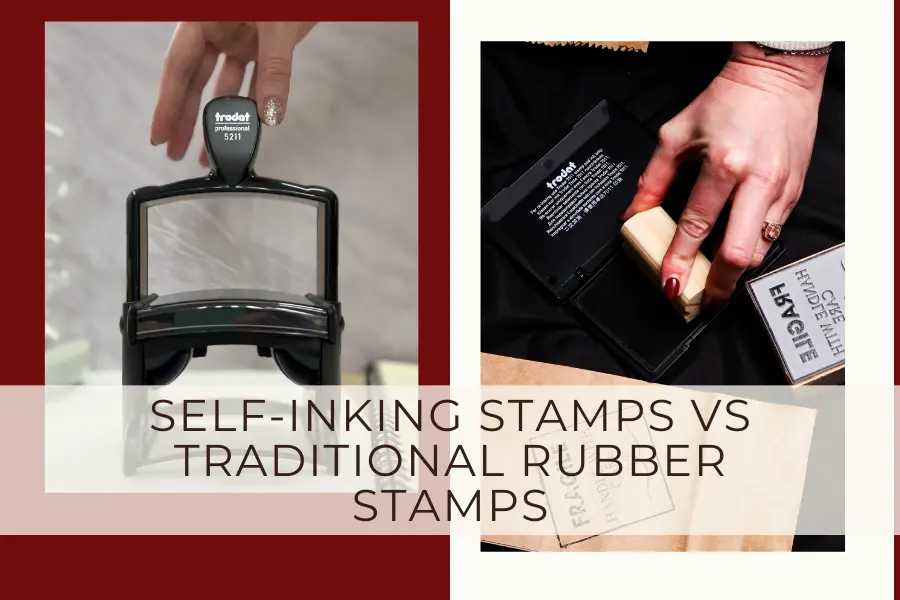
Self-Inking Stamps vs Traditional Rubber Stamps: Which Is Better?
In offices, schools, and businesses across South Africa, the right stamp can save time, reduce errors, and maintain a professional standard. But when choosing between self-inking stamps and traditional rubber stamps, many buyers are unsure which option best suits their needs.
In this guide, we break down the key differences to help you make an informed decision — whether you are approving invoices, dating documents, marking files, or stamping packaging.
What Are Self-Inking Stamps?
Self-inking stamps have an internal ink pad that automatically re-inks the die after each impression. You simply press down, and the mechanism rotates back into the ink pad, ready for the next use.
Explore our range of self-inking text stamps here.
Self-inking stamps are widely used in offices because they are efficient, compact, and clean to operate.
What Are Traditional Rubber Stamps?
Traditional rubber stamps require a separate ink pad. You press the rubber die onto the ink pad and then onto the document. These stamps are typically mounted on a wooden handle.
View our wooden stamp range here.
Traditional stamps are often preferred for larger designs, creative uses, or where multiple ink colours are needed.
Key Differences Explained
Convenience and Speed
- Self-inking stamps are faster to use, making them ideal for high-volume administrative work.
- Traditional stamps require re-inking before each impression, which can slow the process slightly.
Self-inking models are typically better suited to busy finance departments, reception desks, and logistics teams handling repetitive stamping tasks.
Impression Quality
- Traditional stamps can provide deeper, more saturated impressions, especially when freshly inked.
- Self-inking stamps produce consistently clean impressions, though they may appear slightly lighter than a heavily inked traditional stamp.
If your stamp includes a detailed logo or bold design, a traditional stamp may offer slightly more control over ink depth.
Durability and Lifespan
- Self-inking stamps are designed for thousands of impressions before the internal ink pad needs replacing.
- Traditional stamps can last indefinitely with proper care and replacement ink pads.
Both options are reliable when sourced from quality manufacturers and used correctly.
Ink Colour Flexibility
- Self-inking stamps are limited to the ink colours available for their internal pads.
- Traditional stamps allow you to switch ink pad colours easily and use speciality inks when required.
For creative uses, themed events, or celebration stamps, traditional stamps offer greater flexibility.
Explore design options for occasions here.
Specialised Uses
For functions such as tracking deliveries, recording received documents, or managing compliance paperwork, date and time stamps are essential tools.
Browse time and date stamp options here.
These are particularly useful in administrative, legal, and warehouse environments.
For more robust office solutions, professional-grade text stamps are available here.
When to Choose Self-Inking Stamps
Self-inking stamps are ideal if you:
- Stamp documents frequently throughout the day
- Need speed and efficiency
- Prefer a compact, low-maintenance option
- Require a clean and consistent impression
They are particularly effective for company details, invoice markings, approvals, and internal documentation.
When to Choose Traditional Rubber Stamps
Traditional stamps are better suited if you:
- Need flexibility with ink colours
- Use the stamp occasionally rather than continuously
- Require larger or more custom design formats
- Prefer a classic wooden handle style
They are often chosen for creative projects, packaging, and special occasions.
Final Verdict
There is no universal answer — the better option depends on your specific application.
For fast-paced office environments and high-volume use, self-inking stamps offer efficiency and convenience.
For design flexibility, varied ink options, and more customised applications, traditional rubber stamps remain a strong choice.
Many South African businesses find that using both types provides the most practical solution: a self-inking stamp for daily admin tasks and a traditional stamp for branding or specialised uses.
 2019 brew by